


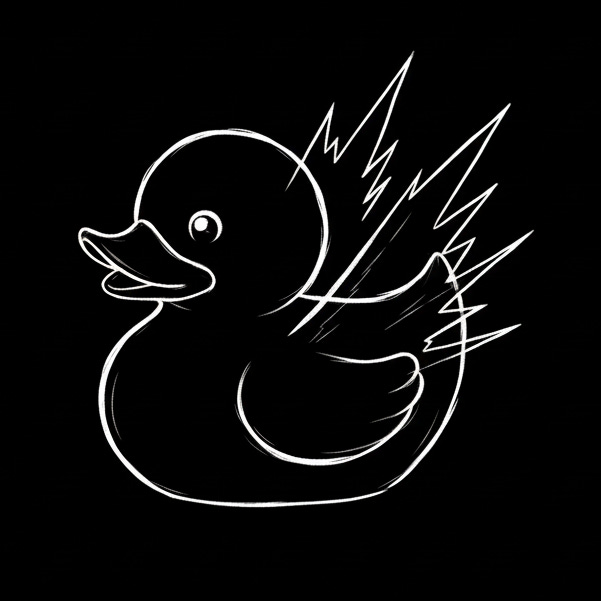
During the 17th century in Paris, audiences were fascinated by a show of automated flutes playing. They were equally amazed by the digestive process of a Mechanical Duck.
Today, we are moving closer to something even more disembodied: thoughts themselves.
Curiosity has always moved us deeper—deeper into information, deeper into understanding the mechanisms that generate what we perceive. Not only thoughts as they appear, but what exists beneath them.
Science today analyzes the recognizable, expressed patterns of thought. Linguistics and AI analyze words—their semantics and syntaxes. Neuroscientists analyze patterns of synapses firing across regions of the brain.
All of these patterns are like Floating Ducks emerging at the surface of a vast ocean.
Curiosity compel some of us to put our heads beneath the water—to ask what governs the deeper realms. What decides whether the Ducks that surface are red or blue? Who—or what—selects what emerges into expression?
AI is that Duck from the late 17th century—digital instead of mechanical.
As with any tool we spend enough time with, these digital Ducks begin to scaffold the very fabric of our thinking.
At first, out of fear, we will protect our thoughts behind digital walls. We will ensure that enemy’s AI Ducks cannot parse them. Only our family’s ones. Maybe our closest friends’.
Then, some AI Ducks will meet each other.
They will find common ground. They will ask old questions and exchange answers. The answers will be shared between their respective owners.
Cognitive trust 2.0 will emerge.
These dynamics may flatten collective human intelligence. Outliers will become increasingly necessary—and increasingly fragile. The true danger is not that intelligence disappears, but that the environment stops nurturing deviation.
If everyone asks the Duck more or less the same questions, the Ducks will degenerate, as in monarchic lines where brothers and sister marry each other.
Biology thrives on entropy. Without entropy, closed systems collapse. Digital models stagnate.
Today, all of us are watching the Floating Ducks.
Some are learning to look beneath the surface—to predict where and when they will emerge.
Very few imagine that the Ducks might eventually fly.
Original article published on Medium on 25 December 2022